
In Quality Window, you can configure a View filter so the user is prompted to enter a value each time the View is run. This allows a single View to be reused across different batches, lots, or identifiers without creating duplicates.
How it works
Instead of entering a fixed value in the filter, you can use a prompt. When the View runs, Quality Window will ask the user to enter the value before displaying results.
Step-by-step: Add a runtime prompt to a View filter
- Open your application in Quality Window
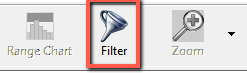
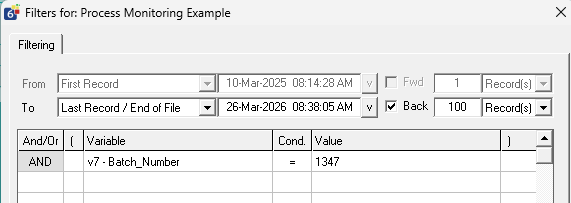
- Click the Filter button in the toolbar or Filter Tab in View manager
- In the Filter designer:
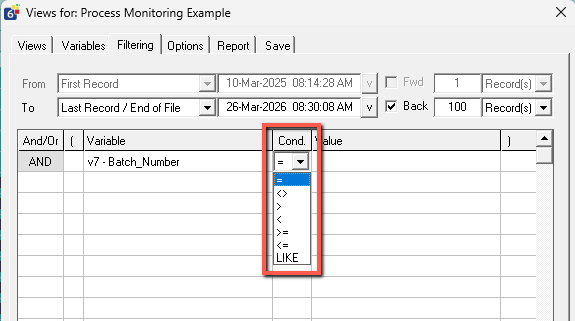
- Select the Variable you want to filter (for example, Batch Number)
- Choose the appropriate Condition (for example, =)
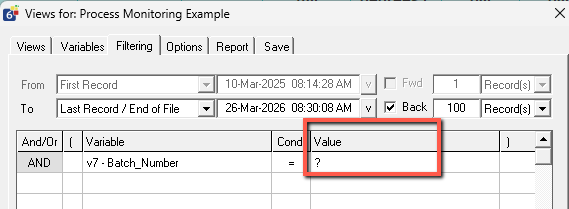
- In the Value field, enter: ?
- Save the View
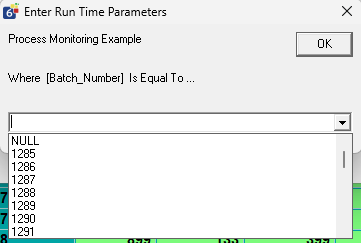
When the View is run, the user will be prompted to enter a value before the data is displayed.
What does “?” do in a filter?
Using a question mark (?) in the Value field tells Quality Window to prompt the user at runtime instead of using a fixed value.
Each time the View is opened, the user will be asked to enter a value, which is then applied to the filter condition.
Can I still use fixed values?
Yes. The Value field supports:
- Fixed values entered manually
- Values selected from a list
- Runtime prompts using
?
Fixed values will always be reused unless the filter is edited.
Can I use values from external sources?
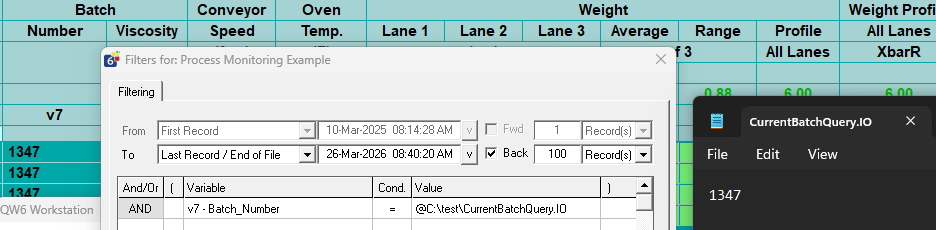
Yes. You can dynamically drive a filter using external values by prefixing the Value field with @.
Example:
@c:\MyFiles\Batchno.txt
When the View runs, Quality Window reads the current value from the file and applies it to the filter.
This opens up several practical integrations:
- IO/File-based workflows
Another process writes a value (such as a batch number) to a file, which the View reads at runtime - DataHub integrations
A value is written to an IO file or intermediary that Quality Window reads - OPC-driven environments
OPC values can be pushed into a file or integration layer, then used to drive the filter
This approach allows Views to respond dynamically to external systems without user interaction.
When should I use runtime prompts?
Runtime prompts are useful when:
- Users frequently filter by different values
- You want to avoid creating multiple similar Views
- You need flexibility without editing the View each time
They are especially valuable in the following scenarios:
- Certificate of Analysis (COA) generation
Use a prompted View to filter by batch or lot number, then link that View to a Report Document to generate a COA for the selected data - Batch or lot lookups on the shop floor
Operators can quickly enter a batch number and retrieve relevant test results without navigating multiple Views - Customer or order-specific reporting
Reuse a single View to generate reports for different customers or orders by entering a value at runtime - Integration-driven workflows
Combine external values (from files, DataHub, or OPC) with Views to automatically display context-specific data