
First, a broad definition: A Certificate of Analysis is a document (electronic or paper) issued by Quality Assurance that confirms that a product meets its product specification. They commonly contain the actual results obtained from testing performed as part of quality control of an individual batch of a product.
A Certificate of Analysis, or commonly called a C of A, is an important component in the manufacturing process of a product or service. It is important to understand the inputs and outputs from every stage of the manufacturing process. Precision with little or no variation is the key to maintaining high efficiencies and low waste in any manufacturing process that brings multiple components or raw materials together to produce a product.
So a good C of A should be made up of detail data that accurately demonstrates the product, lot, or batch meets the exact requirements expected. To accomplish this, detail data must be collected for performance variables at a representative time frame that ensures the product meets the requirements.
Add to that summary statistical data, such as averages and other key measures, with the purpose of providing the customer confidence that the product will meet their exacting needs.

Improving COA generation
Quality Window can be used to record and measure product or customer-specific criteria collected on the production line, in the lab, or both.
Those results can then be used to generate Certificates of Analysis in a format of your choosing. Report Documents can combine live data, statistical summaries, text, images, and tables into a tailored output that can be used to accompany shipments to customers.
For COA use cases that require tighter control over the dataset, a referenced view can be used to narrow the results to a specific batch, lot, product, or time period. Prompted filters can also be used where appropriate.
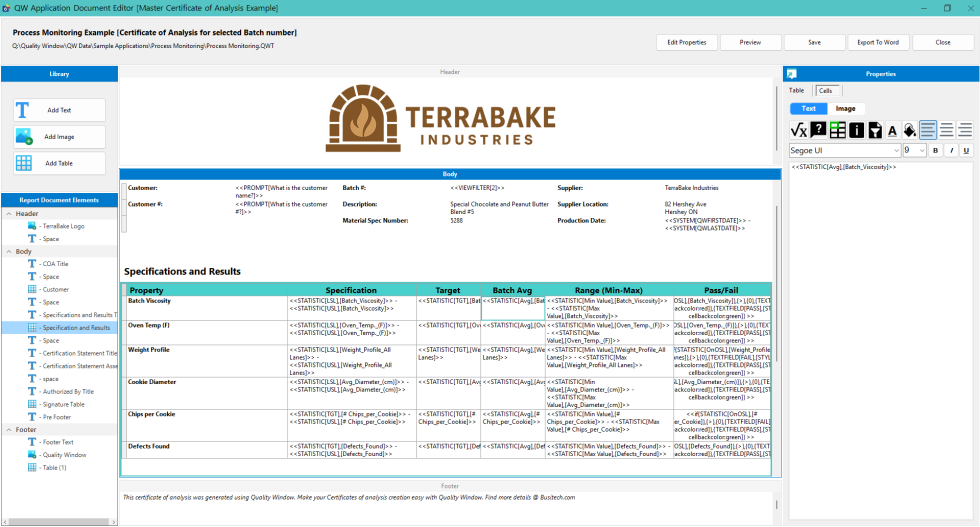
You can refer to this guide for more details on setting up COAs using Report Documents:
Creating Certificates of Analysis (COAs) with Quality Window