
QW Backup is a utility available in QW Admin that allows you to archive complete Quality Window applications into a single file for safekeeping or transfer.
This tool is designed for application-level backups, such as capturing changes, moving applications between environments, or quickly restoring a previous version. It is not intended to replace your organization’s IT-managed backup strategy. You should continue to follow your internal IT policies for full system, server, and data backups.
The backup utility is accessed from QW Admin under Backup Application(s).

Backups are stored as .QWZ files. These are compressed archive files (ZIP format) that contain all components of the selected application.
Creating a Backup
QW Backup allows you to define one or more backup entries, each specifying what to back up and where to store it.
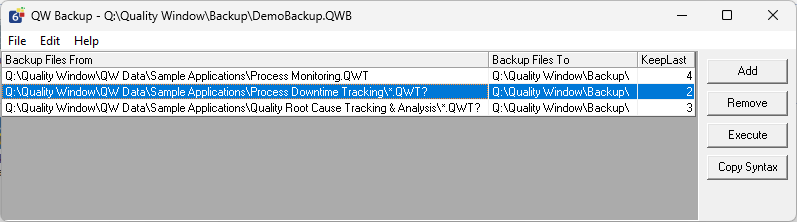
Each entry includes:
Backup Files From
The fully qualified path to the application(s) you want to back up.
Supports:
- Individual applications
- Entire folders
- Wildcards (
*) to include multiple applications
Backup Files To
The destination folder where the .QWZ backup file will be created.
Keep Last
Defines how many previous backup generations to retain before older files are overwritten.
Adding a Backup Entry
To create a new backup definition:
- Click Add
- Browse to the folder containing your applications
- Select one or more applications from the list
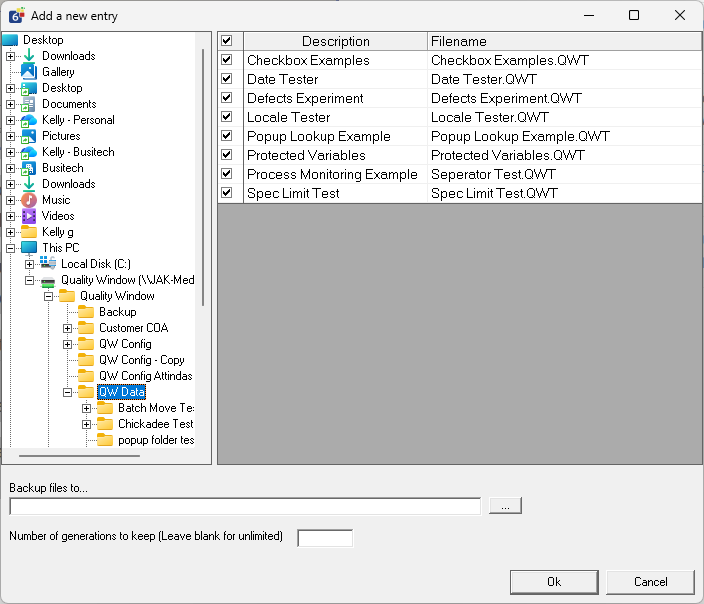
You can select:
- Individual applications
- All applications within a folder
This makes it easy to back up entire environments (for example, all applications under a production folder).
Once added, the entry will appear in the main QW Backup screen.
Running a Backup
To execute a backup:
- Select the desired entry
- Click Execute
A .QWZ file will be created in the specified destination folder.
If you select a single entry and click Copy Syntax, the utility will generate the command line syntax for that specific backup job. This is useful for testing or integrating individual backups into scripts.
Saving and Reusing Backup Tasks
Backup configurations can be saved and reused.
To save a backup configuration:
- Click File > Save As
- Provide a meaningful name
The configuration is saved with a .QWB extension.
This file represents the full list of backup entries and can be reused or automated.
Automating Backups
QW Backup supports automation through both command line execution and the built-in QW Scheduler.
This allows backups to be integrated into your standard operational or IT processes.
Command Line Automation
QW Backup can be executed from the command line using two approaches:
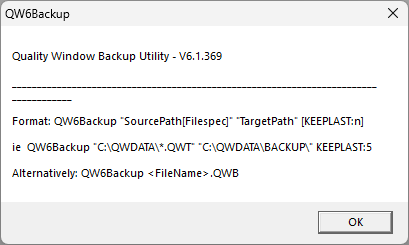
Single Backup Entry (Generated Syntax)
Use the syntax generated from the Copy Syntax button: QW6Backup “C:\QWDATA*.QWT” “C:\QWDATA\BACKUP” KEEPLAST:5
This runs a backup for a specific source and destination.
Saved Task List (.QWB File)
Execute a full saved configuration file: QW6Backup <FileName>.QWB
This will run all backup entries defined in the .QWB file and is the preferred method for automation.
Using QW Scheduler
QW Scheduler provides a built-in way to automate backups without relying on external tools.
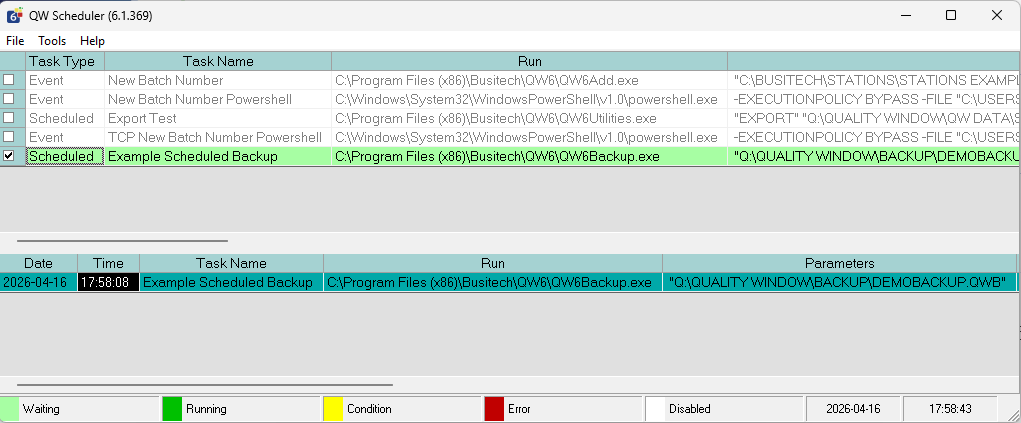
To schedule a backup:
- Create and save a
.QWBbackup configuration - Open QW Scheduler
- Create a new Scheduled task
- Set the Run path to the QW6Backup executable
- Set the Parameters to the
.QWBfile
Example:
Run
C:\Program Files (x86)\Busitech\QW6\QW6Backup.exe
Parameters
“Q:\Quality Window\Backup\DemoBackup.QWB”
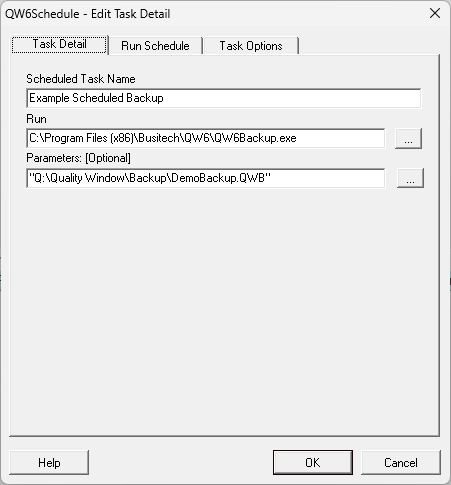
You can then define when the backup runs:
- Daily or weekly schedules
- Specific start times
- Optional date ranges
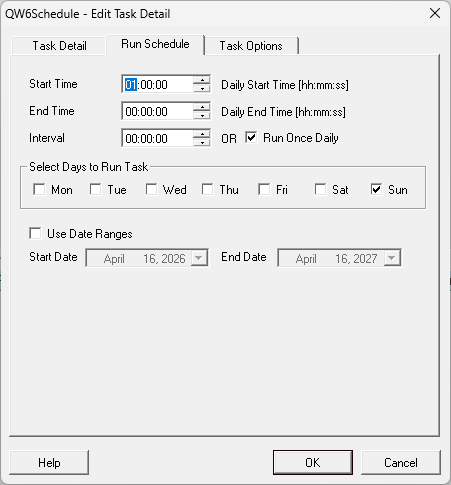
Choosing an Automation Approach
- Command line → best for integration with IT-managed schedulers
- QW Scheduler → best for users managing backups directly within Quality Window
For most environments, using a saved .QWB file with QW Scheduler provides a simple and reliable backup process.
Automatic Backups in QW Admin
Any time changes are made to an application in QW Admin, a full backup of the application is automatically created.
This is especially important when modifying:
- Variables
- Data structures
- Application configuration
If a change introduces an issue, the previous version can be restored using the restore process below.
Restoring an Application
The Restore tool allows you to extract a .QWZ backup file to any location.
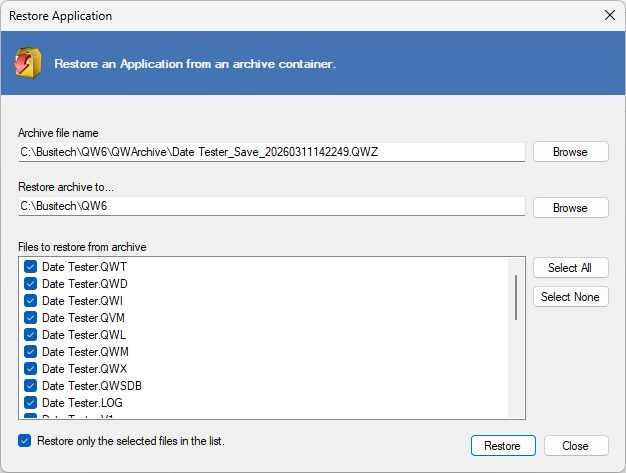
Archive File Name
Select the .QWZ file you want to restore.
Restore Archive To
Choose the destination folder where the application will be restored.
Files to Restore
All application files are listed, including:
- Application structure (QWT)
- Data (QWD)
- Views, IO files, and supporting components
You can:
- Restore the full application (recommended)
- Select specific files to restore (advanced use)
If the application already exists in the target location, you will be prompted to overwrite.
Important Notes on Partial Restores
While the tool allows restoring individual files, this should be done with caution.
Application components are tightly linked. Restoring only part of an application (for example, only the QWT or QWD file) can lead to inconsistencies or data issues.
If you are unsure:
- Restore the full application, or
- Contact Support before performing a partial restore
What Is Included in a Backup
A .QWZ backup includes all files associated with the application, such as:
- Application structure and data
- Popup files
- IO files
- Supporting configuration files
This ensures a complete snapshot of the application at the time of backup.